Sidel CREN Offers Free Waste Heat Site Studies to Industrial Plants, With Measured Pilots Before Any Scale-Up
The U.S.–India–Canada alliance combines a flue-gas condenser, a patented particulate collector and phase-change thermal storage into one platform for recovering heat that plants already pay for.
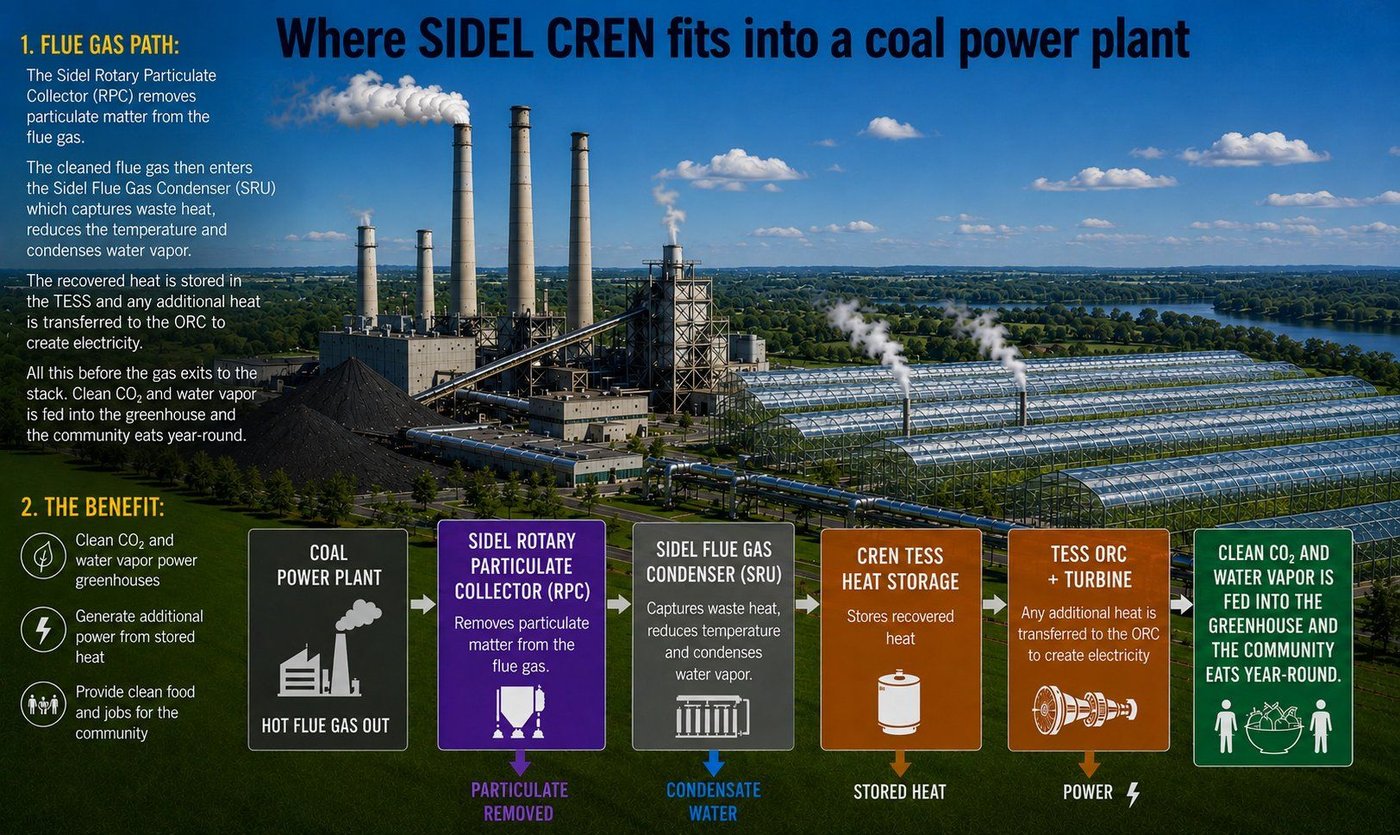
Photo: Sidel CREN
DENVER, Colorado, October 21, 2026 —
Roughly half the energy industry pays for leaves through chimneys, condensers and cooling towers. Sidel CREN, a waste heat recovery company based in Denver, is offering industrial plants a free, no-obligation consultation to measure how much of that heat they could recover and put back to work.
Sidel CREN, the operating name of Carbon Resilient Energy NEXUS, Inc., brings together three technologies from alliance partners in the United States, India and Canada and delivers them as a single, integrated retrofit.
Three technologies, one platform
- SRU Flue Gas Condenser from Sidel Systems USA: a condensing economizer that recovers sensible and latent heat from boiler and generator exhaust, and condenses water vapour where the chemistry allows. Sidel condensing technology has been in the field since 1978, with more than 100 commercial and industrial clients.
- Rotary Particulate Collector (RPC) from SAI-DEL / Sidel Systems India: a self-cleaning collector for coal, wood, biomass, municipal waste and fuel oil exhaust, invented by Parthosarathy Mukherji (U.S. Patent 9,682,340). On a 75 TPH bagasse-fired cogeneration boiler at a sugar mill in Maharashtra, India, a single RPC brought stack particulate down from 150 to 32 mg/Nm³.
- Novacab TESS from Smart Phases Inc.: thermal energy salvage, storage and conversion using synthetic phase change materials, invented by Dr. Stephane Bilodeau, Eng., Ph.D., FEC. Its foundation, a phase-change thermal storage project at IBM's Bromont, Quebec plant, won a 2007 ASHRAE Technology Award, and roughly 400 Novacab TESS units are now installed across Canada.
Together, the system captures particulate, recovers heat and water from the flue gas, stores the heat, and converts qualifying heat into on-site electricity through an organic Rankine cycle turbine. At suitable sites, cleaned CO₂ and water vapour can also feed a greenhouse.
Measured before it scales
Sidel CREN's process is built around measurement rather than promises:
1. Consultation. A plant shares its type, fuel and biggest thermal pain point, virtually or on site. 2. Data request and plan. Sidel CREN reviews utility bills, boiler and steam logs, stack temperatures, cooling and water balance and production data, then builds a heat and water balance and a conservative cost-benefit analysis. 3. Bypassable pilot. The pilot runs in parallel with existing systems for 30 to 90 days. Plants scale only after metered fuel, water, output, emissions and uptime data support it.
The company describes its headline figures, such as 8–10% lower fuel input and 20–25% more net output at power plants, as engineered targets from reference plants and analysis. Site-specific numbers come only after a metered baseline and pilot.
Industries served
Sidel CREN focuses on dairy, sugar mills, fossil power, steel and metals, data centers and concrete, along with other manufacturers with large boiler, stack or cooling loads. Its website includes plain-language guides on boiler stack heat loss, condensing economizers, cooling tower water loss, data center heat reuse and turning waste heat into electricity.
Plants can request a consultation at sidelcren.com or call (805) 462-1250.
About Sidel CREN
Sidel CREN (Carbon Resilient Energy NEXUS, Inc.) is a waste heat recovery and power generation platform headquartered in Denver, Colorado. It integrates technologies from Sidel Systems USA, SAI-DEL / Sidel Systems India and Smart Phases Inc. / Novacab into one accountable, cross-border delivery model.
*Disclosure: Tech News Company's owner builds and maintains the Sidel CREN website.*
Media contact
Michael Logan, President & Chairman, Sidel CREN